
Exact duplicate
Same supplier, same invoice number, same date and same amount as a bill already booked or paid.
- Typically the same document received twice
- Held from the payment run automatically
Paying the same supplier bill twice is one of the most common leaks in accounts payable, and one of the hardest to see. Shodhan checks every incoming bill against twelve months of history, holds the ones that look like repeats, and shows your team exactly why — so the decision is made before the money leaves, not during the audit.
Sample data
Duplicate payments rarely come from carelessness. They come from the same bill reaching you twice in slightly different forms, at a time when the team is under pressure to release the payment run.
The supplier emails the PDF, then posts the hard copy or uploads it to a portal. Each copy is entered by a different person.
INV-0452 becomes INV 452, 0452/25-26 or 452A. Your accounting system sees a new invoice number and lets it through.
The same supplier sits in the vendor master twice, under slightly different names. A bill booked against each code never collides.
The repeat surfaces at vendor reconciliation or audit, after payment. Recovery then depends on the supplier's goodwill and your follow-up.
Most accounting systems block a second bill only when the vendor code and the invoice number are identical. Anything short of that passes.
Not every match deserves the same response. Shodhan grades each flag so your reviewer knows how much attention it needs.
Same supplier, same invoice number, same date and same amount as a bill already booked or paid.
Same supplier and amount, but the invoice number or date differs slightly: a dropped zero, an added suffix, a re-typed date.
Enough in common to deserve a look: the same amount and PO within a short period, or the same bill against a second vendor code.
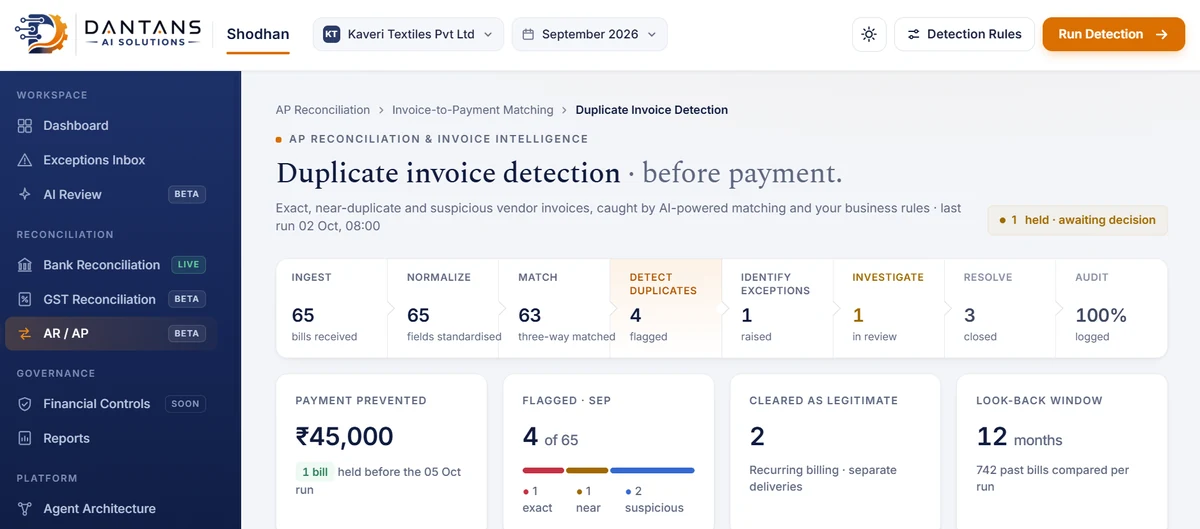
The check runs before every payment run, and on demand. Each step is visible on the screen, with a count, so you can see where every bill stands.
Supplier bills are brought in from email, scans, uploads and your purchase register.
Invoice numbers, dates, amounts, GSTINs and supplier names are put into one standard form, so INV-0452 and inv 452 read as the same number.
Each bill is matched three ways: to its purchase order and to the goods receipt.
The bill is compared with the past twelve months of bills, paid and unpaid, and graded exact, near or suspicious.
Flags your business rules explain, such as monthly rent or split deliveries, are cleared. The rest become exceptions.
The reviewer sees both bills side by side, what matches, what differs and whether the earlier one was paid.
Your team decides: release, reject and return to the supplier, or keep on hold. Nothing is paid or cancelled without that decision.
Every flag, reason, decision and approver is logged, ready for internal and statutory auditors.
A duplicate usually agrees on several details even when one of them has been changed. Shodhan weighs them together.
| Detail | What Shodhan checks | Why it matters |
|---|---|---|
| Supplier | GSTIN, PAN, bank account and name, across all vendor codes | Finds the same supplier set up twice in the vendor master |
| Invoice number | Compared after removing spaces, punctuation, prefixes, year suffixes and leading zeros | Catches re-typed and re-formatted numbers |
| Invoice date | Same date, and dates a few days apart | Catches re-issued and re-dated copies |
| Amount | Taxable value, GST and total, including small rounding differences | Catches copies keyed with or without tax, or rounded differently |
| PO and goods receipt | Whether the same order line or receipt has already been billed | Separates a second delivery from a second bill for the same delivery |
| History | Twelve months of past bills, paid and unpaid | Catches a repeat that arrives months after the original was paid |
A check that holds every similar bill would stop the payment run. These are recognised and cleared, using rules your team controls.
Rent, retainers, AMCs and subscriptions: the same supplier and amount every month, by design.
Two bills for the same amount against one PO, each supported by its own goods receipt.
Equal stage payments under one contract, billed on different dates.
A corrected bill that replaces an earlier one, where the original has a credit note against it.
Figures are sample data from the product screen above, shown to illustrate the workflow. They are not client results.
| Question | Manual today | With Shodhan |
|---|---|---|
| When is a duplicate found? | At vendor reconciliation or audit, after payment | Before the payment run |
| What is checked? | Vendor code and invoice number, if they match exactly | Supplier identity, number, date, amount, PO and receipt, together |
| How far back? | As far as someone remembers | Twelve months of bills, every run |
| Who decides? | Whoever notices | A named reviewer, with both bills side by side |
| What is on record? | An email trail, if any | The flag, the reason, the decision and the approver |
| Genuine repeat bills | Questioned every month | Recognised by your rules and released |
For a finance head, the value is a control that works before payment and leaves evidence behind.
It usually stops a second bill only when the vendor and the invoice number are exactly the same. A re-typed number, a second vendor code or a re-dated copy passes. Shodhan compares several details together, after standardising them.
No. The check runs before the payment file is prepared, and only flagged bills are held. In the example above, 61 of 65 bills were never touched.
No. Recurring bills, split deliveries and instalments are recognised by rules your team sets, and released without review.
No. It holds the bill and explains why. Releasing, rejecting or returning it to the supplier is always a decision by an authorised person, and that decision is logged.
Each bill is compared with twelve months of past bills, paid and unpaid, so a repeat is caught even when the original has long been settled.
With a two-week pilot on your own purchase register and recent bills. We run the check on your history first, so you see what it would have flagged before you rely on it.
Duplicate detection sits alongside three-way matching and reconciliation in the same product.
Bank, GST, AP, AR, ledger and payment reconciliation with exception resolution.
Explore Shodhan →Payables control, reconciliation, forecasting and collections for finance teams.
Back to Finance & Cash Flow →GSTR-2B matching and input credit at risk, alongside your payables.
Explore GSTGenie →Share your purchase register and recent bills, and we'll show you what Shodhan flags, on your own data.